
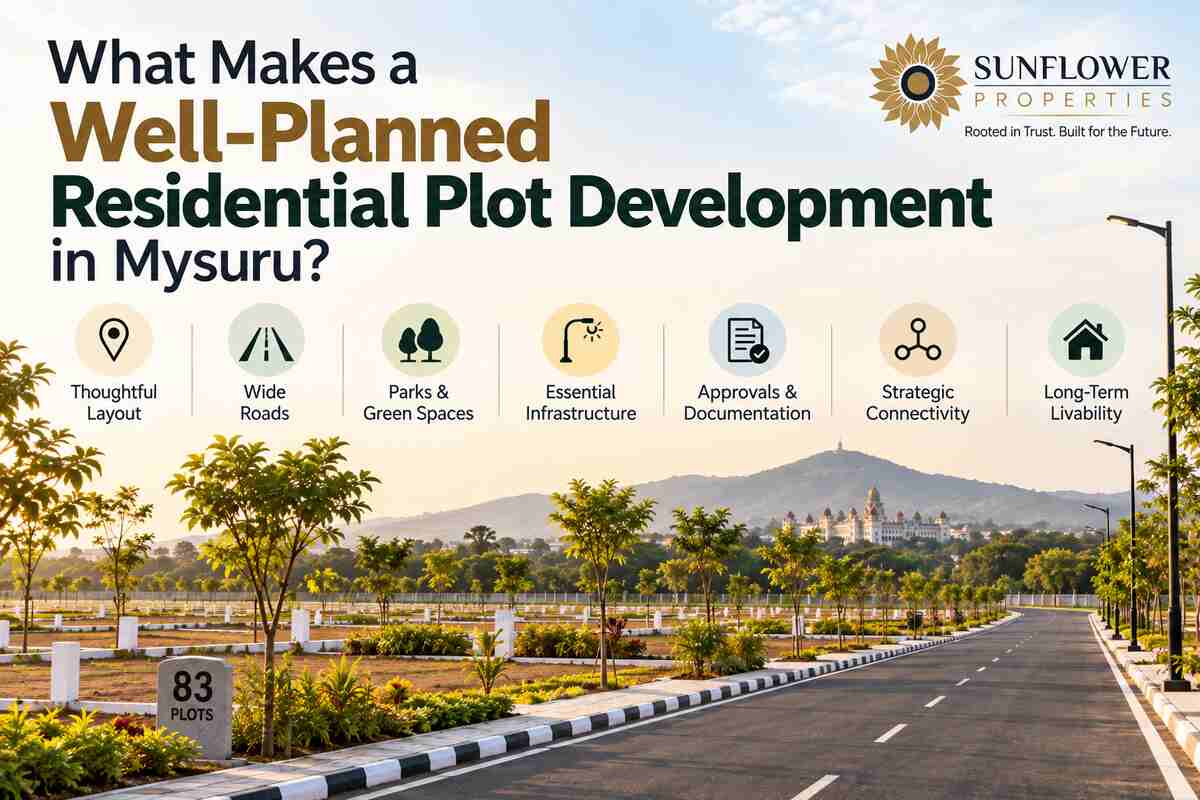
What Makes a Well-Planned Residential Plot Development in Mysuru?

When buying a residential plot, it is easy to focus on the individual site.
What is the size?
Which direction does it face?
What is the price?
Where is it located?
But a residential plot does not exist in isolation.
The road outside your plot, the layout around it, the infrastructure, open spaces, drainage, lighting, surrounding development and access to the wider city can all influence what it is like to eventually build and live there.
That is why, when evaluating a plotted development in Mysuru, buyers should look beyond the individual site and understand how the entire development has been planned.
So, what makes a residential plot development well planned?
Let’s look at the things that matter.
1. Good Planning Starts With the Layout
A plotted development should be considered as a complete community rather than simply a collection of individual sites.
A well-planned layout should consider:
- Internal roads
- Plot access
- Open spaces
- Parks
- Infrastructure
- Drainage
- Utilities
- Pedestrian movement
- Vehicle movement
- Future residential use
The objective isn’t simply to fit as many plots as possible into a piece of land.
The layout should also create an environment in which people can eventually build and live comfortably.
This is particularly important for buyers purchasing land with the intention of constructing their own homes.
2. Internal Roads Matter More Than They First Appear
The road directly serving your plot becomes part of your everyday experience.
It affects:
- Car access
- Parking
- Construction material movement
- Emergency access
- Visitor movement
- Overall openness of the development
When visiting a plotted development, don’t simply ask:
“Are there roads?”
Ask:
“What are the actual internal road widths, and what condition are they in today?”
At Sunflower Enclave, the internal roads are planned at 9 metres wide, and the project currently states that the roads have been completed.
That is something a buyer can actually see and evaluate during a site visit.
3. Approach Road Is Just as Important as the Internal Road
A layout can have good internal roads but still be inconvenient if the approach to the development is poor.
Before buying, look at the complete journey:
Main road → approach road → layout entrance → internal road → your plot
Ask:
- How easy is it to reach the layout?
- Is the approach road wide enough?
- Is it usable throughout the year?
- How does it connect to the major roads?
- How long does the final stretch actually take?
This is why we discussed actual access rather than just map distance in our earlier guide on residential plots near Mysuru Ring Road.
A location can be close to a major road on a map and still have a very different on-ground experience.
4. Infrastructure Should Exist, Not Just Appear in a Brochure
This is one of the most important distinctions for a plot buyer.
There is a difference between:
“Infrastructure is planned.”
and
“Infrastructure is already in place.”
When visiting a development, look for the infrastructure that exists today.
Depending on the project, this can include:
- Roads
- Street lighting
- Drainage
- Water infrastructure
- Electricity
- Sewage treatment
- Parks and open spaces
- Other essential utilities
Sunflower Enclave currently lists completed roads, installed street lighting and an STP among its infrastructure.
For a buyer, the important thing is not simply reading that on a website.
Visit the site and see the development for yourself.
5. Green Spaces Should Be Part of the Planning
A residential development is ultimately intended for people to live in.
That makes open spaces and greenery more than just decorative features.
A planned residential layout may incorporate:
- Dedicated parks
- Open spaces
- Green areas
- Tree-lined roads
- Spaces that create visual separation between built-up areas
Sunflower Enclave includes a dedicated park area and positions greenery as part of its residential environment.
When evaluating a project, look at the actual location of these spaces rather than simply checking whether the brochure mentions a park.
6. Think About the Neighbourhood, Not Just the Plot
Your future home will be surrounded by other homes.
So ask:
- Is the surrounding area residential?
- Are neighbouring properties already occupied?
- Are other homes being constructed?
- What kind of development is happening nearby?
- Are there commercial or industrial activities close to the layout?
- What does the area feel like during the day?
- How accessible are schools, hospitals and everyday necessities?
This is particularly important if you intend to build your primary residence rather than simply hold the property as an investment.
7. Connectivity Should Be Evaluated From the Actual Site
Connectivity is one of the reasons buyers consider plotted developments around Mysuru’s Ring Road.
But “near Ring Road” alone isn’t enough.
Look at:
- Actual distance
- Approach road
- Junction access
- Travel time
- Connectivity to other parts of Mysuru
- Access to schools and hospitals
- Access to everyday shopping
- Your own regular commute
Sunflower Enclave is currently positioned at less than 200 metres from Mysuru Ring Road and less than 1 km from Srirampura Junction.
These are useful location facts, but the best way to understand them is still to visit the site and experience the route yourself.
8. Approval and Documentation Are Part of Good Planning
A well-planned physical layout is only one part of the equation.
The legal and documentation side matters just as much.
For example, the Mysuru City Corporation’s current guidance for new khata/property registration lists documents including the sale deed, Encumbrance Certificate, land conversion documentation and urban-development-authority approval/layout plan.
This is why buyers should ask:
- What authority has approved the layout?
- What approval documents are available?
- What are the applicable land-use/conversion records?
- What property documentation is available?
- What is the current registration status?
- Can the documents be independently verified?
Sunflower Enclave currently identifies itself as a MUDA-approved layout and ready for registration.
Buyers should still review the relevant documents and obtain independent professional advice where appropriate.
9. Plot Orientation Should Be Considered Alongside the House You Want to Build
A plotted development may offer different orientations.
Some buyers have a strong preference for east-facing sites. Others may consider west-facing sites based on their house plan, requirements or personal preferences.
The important thing is to understand:
How does the individual plot work for the house you want to build?
Consider:
- Main entrance
- Parking
- Natural light
- Ventilation
- Room arrangement
- Setbacks
- Future expansion
Sunflower Enclave currently offers both east- and west-facing sites.
The right choice ultimately depends on the buyer’s requirements and the house design.
10. A Good Development Thinks Beyond the Individual Plot
This is perhaps the biggest difference between simply buying a piece of land and buying into a planned plotted development.
The question shouldn’t only be:
“Is my plot good?”
It should also be:
“Is the development around my plot being planned properly?”
Look at the relationship between:
Plot → Road → Infrastructure → Open Space → Neighbourhood → City
All of these eventually become part of your living experience.
What Should You Look for During a Site Visit?
Before making a decision, walk through the development and evaluate it physically.
Layout
- Is the layout easy to understand?
- Are the plots accessible?
- Are roads properly laid?
- Are open spaces clearly identifiable?
Roads
- What are the actual road widths?
- Are they completed?
- Is access convenient?
Infrastructure
- Are streetlights installed?
- What drainage arrangements exist?
- Is electricity infrastructure visible?
- Is sewage infrastructure available where applicable?
Surroundings
- What is being developed around the layout?
- Are there existing homes?
- Are there vacant parcels?
- Is the environment predominantly residential?
Connectivity
- How do you reach the development?
- How long does the approach take?
- How convenient is the route to your regular destinations?
Documentation
- What approvals are available?
- What property documents can be reviewed?
- What is the current registration status?
A Simple Way to Evaluate a Residential Plot Development
Instead of evaluating only the plot price, consider five broad areas:
| Area | What to evaluate |
|---|---|
| Location | Connectivity and surroundings |
| Layout | Roads, access and overall planning |
| Infrastructure | What is actually developed today |
| Documentation | Approvals and property records |
| Livability | Whether the development suits your future home |
This doesn’t produce a universal score for a property.
It simply gives buyers a more complete framework for asking the right questions.
How Sunflower Enclave Fits Into These Considerations
Sunflower Enclave is the first landmark development from Sunflower Properties.
The project currently comprises 83 residential sites and is positioned as a residential plotted development near Mysuru Ring Road. The project page identifies:
- 9-metre-wide internal roads
- Dedicated park area
- Street lighting
- STP
- East- and west-facing sites
- MUDA approval
- Ready-for-registration status
- Less than 200 metres from Mysuru Ring Road
- Less than 1 km from Srirampura Junction
These are project attributes buyers can evaluate when they visit the site.
We believe that is the right way to approach a residential development:
Don’t simply look at the plot. Look at everything around it.
You can explore Sunflower Enclave and request a site visit to evaluate the layout and location yourself.
What Makes a Residential Development Worth Considering?
There isn’t one feature that makes a plotted development suitable for every buyer.
For some, connectivity may be the priority.
For others, infrastructure or surrounding greenery may matter more.
Some buyers may want to build immediately, while others may be planning for the future.
A well-planned residential development should therefore be evaluated as a complete environment, not simply as individual plots on a layout plan.
Look at the roads.
Look at the infrastructure.
Look at the surroundings.
Understand the approvals.
Think about your future home.
And most importantly, visit the development before making your decision.
At Sunflower Properties, our approach is built around three principles: Trust, Quality and Long-Term Value. The company’s current positioning describes its focus as thoughtfully planned developments that balance connectivity, infrastructure and long-term vision.
Rooted in Trust. Built for the Future.
Frequently Asked Questions
What is a well-planned residential plot development?
A well-planned residential plot development considers more than individual plot sizes. It typically involves coordinated planning of roads, access, open spaces, infrastructure, utilities, approvals and the surrounding residential environment.
What should I check in a plotted development?
Check the location, approach road, internal roads, infrastructure, open spaces, surrounding development, applicable approvals, documentation and how well the individual plot suits your future home.
Are wider internal roads important in a residential layout?
Road width can affect vehicle access, parking, construction activity, emergency access and everyday movement. Buyers should check the actual road width rather than relying only on promotional descriptions.
Why are open spaces and parks important in a plotted development?
Open spaces and parks can contribute to the overall residential environment and provide shared green areas within the development. Buyers should verify the location and extent of these spaces in the approved layout and during a site visit.
What does MUDA approval mean for a plotted development?
MUDA approval indicates approval by the Mysuru Urban Development Authority in the applicable development process. Buyers should still review the relevant approval documents and independently verify the property’s legal and documentation status.
Is Sunflower Enclave a MUDA-approved layout?
The Sunflower Enclave project page currently identifies the development as a MUDA-approved layout and states that it is ready for registration. Buyers should review the relevant project documentation before purchase.