
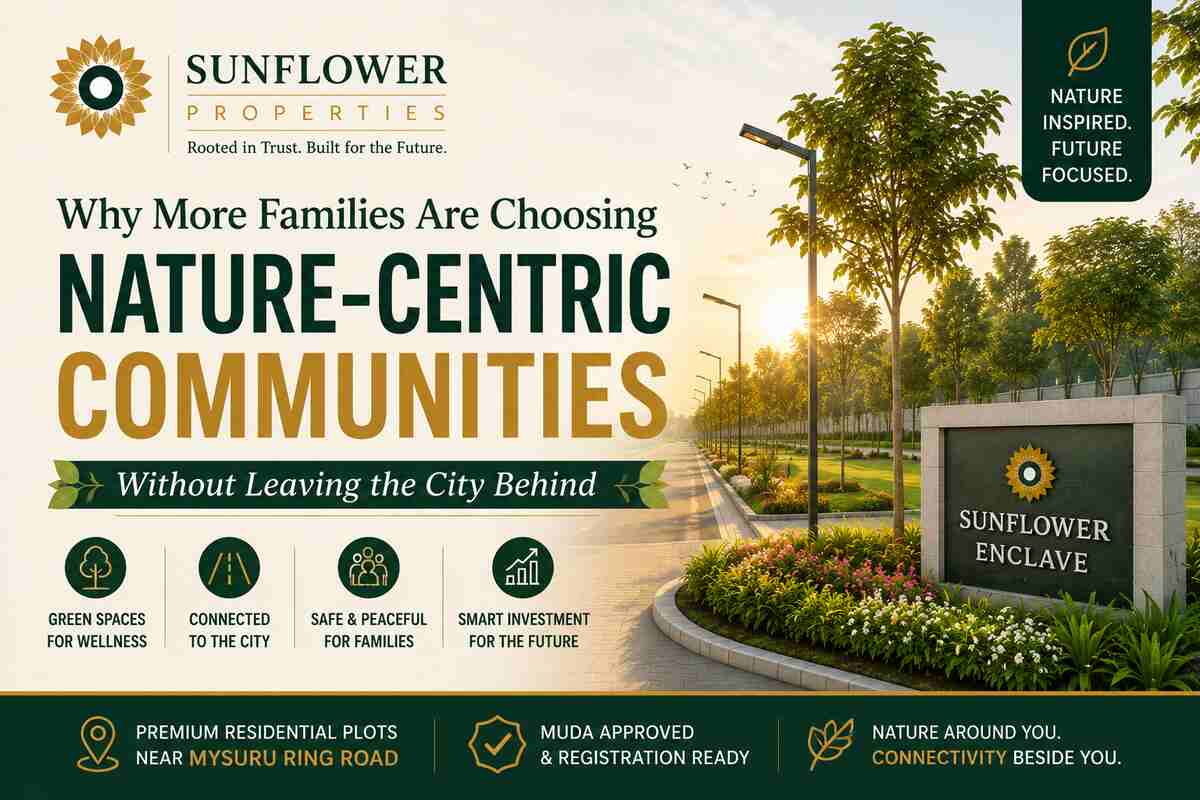
Why More Families Are Choosing Nature-Centric Communities Without Leaving the City Behind

For decades, homebuyers had to make a difficult choice.
Live inside the city for convenience.
Or
Move farther away for peace, greenery, and open spaces.
Today, that choice is disappearing.
Across Mysuru, a new generation of residential developments is emerging—communities that offer the calmness of nature while maintaining access to the city’s infrastructure, employment hubs, schools, hospitals, and lifestyle destinations.
Families are no longer searching only for a plot.
They are searching for a better way to live.
A place where children can grow up surrounded by greenery.
Where mornings begin with fresh air instead of traffic noise.
Where everyday life feels slower, healthier, and more intentional.
This shift is reshaping how premium residential communities are being planned across Mysuru.
The Rise of Nature-Centric Living
Modern families are increasingly prioritising wellbeing over density.
Post-pandemic lifestyles have accelerated interest in homes that provide:
✓ Open landscapes
✓ Walking spaces
✓ Green zones
✓ Tree-lined streets
✓ Cleaner surroundings
✓ Better air quality
✓ Reduced congestion
✓ Community-focused planning
People no longer see green spaces as amenities.
They see them as necessities.
Why This Trend Is Growing in Mysuru
Mysuru already enjoys a reputation as one of India’s most liveable cities.
However, buyers are becoming selective about where within the city they invest.
They are looking for communities that combine:
- Urban accessibility
- Lower population density
- Planned infrastructure
- Natural surroundings
- Future appreciation potential
This is especially true among:
- Working professionals
- NRIs
- Young families
- Retired homeowners
- Long-term investors
What Families Actually Want Today
The definition of a good neighbourhood has evolved.
Ten years ago buyers focused on:
- Plot price
- Distance to city centre
- Basic infrastructure
Today the priorities are very different.
Families are asking questions such as:
- Is there enough greenery?
- Will my children have open spaces?
- Is the neighborhood peaceful?
- Will traffic increase significantly over time?
- Is the community planned for future growth?
- Will the investment retain its value over the next decade?
These factors influence not just quality of life but also long-term asset appreciation.
Nature Improves Everyday Living
Research across urban planning studies consistently highlights the benefits of living near green environments.
Residents living in greener neighbourhoods often experience:
Better physical wellbeing
Open spaces encourage walking, cycling and outdoor activities.
Reduced stress
Natural surroundings contribute to improved mental wellness.
Healthier family lifestyles
Children spend more time outdoors and less time indoors.
Community interaction
Well-designed communities naturally foster social connections.
Improved visual appeal
Landscaped environments age better and retain desirability.
For many buyers, these benefits outweigh the appeal of crowded urban pockets.
Connectivity Still Matters
Nature alone isn’t enough.
Families still want access to essential destinations.
The most successful residential communities combine greenery with connectivity.
Buyers increasingly evaluate access to:
- Ring Road connectivity
- Schools
- Hospitals
- Retail destinations
- Employment hubs
- Highway access
- Upcoming infrastructure corridors
This creates a balanced lifestyle.
You enjoy peaceful surroundings without compromising convenience.
The New Definition of Luxury
Luxury in residential real estate is changing.
Previously luxury was defined by:
- Clubhouses
- Large buildings
- Premium interiors
Today luxury increasingly means:
- Space
- Privacy
- Clean surroundings
- Low-density communities
- Landscape planning
- Tree-lined avenues
- Better quality infrastructure
- Long-term liveability
People are choosing environments that feel open rather than crowded.
Communities designed around nature are becoming aspirational investments.
Why Buyers Are Looking Beyond Traditional Layouts
Not all layouts are designed equally.
Modern homebuyers evaluate the overall ecosystem.
Questions buyers ask include:
- Is the project legally approved?
- Are roads completed?
- Are utility networks ready?
- Is landscaping planned?
- Is drainage managed properly?
- Are public spaces maintained?
- Is there room for future growth?
Projects that answer these questions positively naturally attract family buyers.
Sustainable Living Is Becoming a Priority
Environmental awareness is influencing purchase decisions.
Homebuyers increasingly value communities that embrace:
- Green planning
- Water-sensitive design
- Open spaces
- Responsible infrastructure
- Thoughtful landscaping
- Reduced urban heat impact
Sustainability is no longer viewed as a niche concept.
It is becoming a mainstream expectation.
Mysuru Is Well Positioned for This Shift
Mysuru offers several advantages for nature-centric development.
These include:
- Pleasant climate
- Lower density compared to metros
- Expanding infrastructure
- Strong residential demand
- Better quality of life
- Growth corridors around Ring Road regions
- Increasing investor interest
As the city expands, communities that preserve openness and greenery are expected to become even more valuable.
What Buyers Should Look For
Before investing in a residential community, families should evaluate:
- Legal approvals
- Infrastructure readiness
- Road quality
- Green coverage
- Future development potential
- Connectivity advantages
- Neighbourhood character
- Safety
- Long-term appreciation potential
The right investment combines lifestyle benefits with financial value.
Final Thoughts
Families today are redefining what home means.
It is no longer just about owning land.
It is about creating a lifestyle.
A place where convenience meets tranquillity.
Where children have room to grow.
Where greenery becomes part of everyday life.
And where connectivity ensures you remain close to everything that matters.
The future belongs to communities that successfully balance nature, planning, and accessibility.
For many buyers in Mysuru, that balance is becoming one of the most important considerations in making a long-term real estate decision.
Frequently Asked Questions (FAQ)
What is a nature-centric residential community?
A nature-centric community is a residential development designed around green spaces, landscaping, open areas, and low-density planning while maintaining access to urban infrastructure.
Why are families choosing nature-focused communities?
Families seek healthier environments, cleaner surroundings, open spaces for children, reduced congestion, and improved quality of life.
Are nature-centric communities good investments?
Yes. Communities with strong infrastructure, connectivity, legal clarity, and green planning often experience sustained demand and long-term appreciation.
What features should buyers look for?
Buyers should consider approvals, infrastructure readiness, open spaces, landscaping, road quality, utility access, and future connectivity.
Why is Mysuru suitable for nature-centric developments?
Mysuru combines strong infrastructure growth, favourable climate, lower density, and expanding residential corridors, making it attractive for sustainable community development.